
Mom Lost 3 Children in a Car Crash, Then Had Triplets. Now She’s Been Diagnosed with Stage 4 Brain Cancer

“How could this be happening to us again?” Chris Coble says about their family’s heartbreaking trauma

Lori Coble was in standstill traffic on the freeway on May 4, 2007, when a big rig slammed into the back of her minivan. The mom from Orange County, Calif., had been driving home to put her three kids — Kyle Christopher, 5, Emma Lynn, 4, and Katie Gene, 2 — down for a nap. None of the children survived the crash.

Devastated, Lori and her husband, Chris Coble, made a pact not to end their own lives and to support each other through the traumatic aftermath. They mourned their children deeply and still wanted to be parents.

After exploring adoption and failing to reverse Chris’ vasectomy, they pursued IVF. They were left with three viable embryos: two girls and a boy. “Exactly like we lost,” says Chris, now 54.
courtesy of Chris Coble

As Lori told Oprah Winfrey in 2010, it seemed like a sign. She and Chris told the fertility doctor they wanted to implant all three, “cross our fingers and hope for the best,” Chris says.

The triplets were born almost exactly a year after the deaths of their older siblings. They each carry an older sibling’s middle name: Jake Christopher, Ashley Lynn, Ellie Gene.

“It took me over four years to come out of the fog and pain of what happened,” Chris says. “The first three years of raising the triplets you have this mix of joy and happiness and at the same time, you’re in pain on the inside. There’s these three babies and they’re all joy…. But at the same time, I was trying to avoid falling apart in front of them, I’d go into the other room and cry real quick and come back and put a smile on my face.”

Lori dove into motherhood and raising her triplets, all the while campaigning for highway safety to help protect other children.

“She is extraordinary — everybody who knows her, loves her,” says family friend, Becky Leonard, 45. “First and foremost, she’s a mom.”
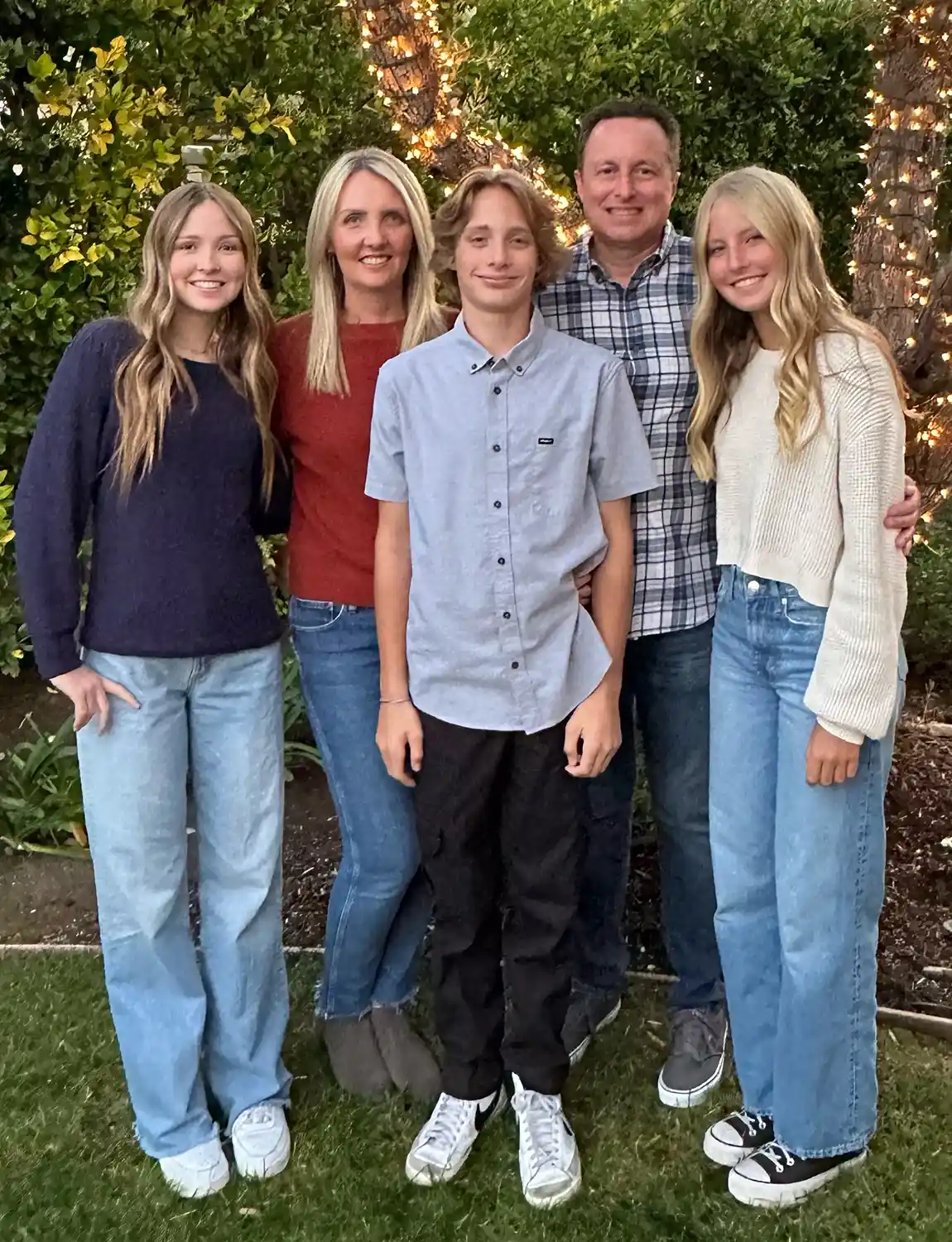
Ashley, Lori, Jake, Chris and Ellie Coble in December 2022.
courtesy of Chris Coble

In June 2025, Chris noticed that 48-year-old Lori was “getting more clumsy.” She would run into walls, stub her toe on chairs, or drop drinking glasses on the floor. In early July, he noticed stroke-like symptoms. “Her mouth started to droop a little bit,” he says. “It became too much to ignore.”

On July 11, he took his wife to the ER at Mission Hospital in Mission Viejo, Calif. There she was diagnosed with a very large, very aggressive, stage 4 glioblastoma. The diagnosis of brain cancer shook their family.

“I was hoping we were done with the life-changing, life-altering disasters where life as you knew it yesterday is gone,” Chris tells PEOPLE.

Doctors told Lori she had two choices: try to fight the cancer, or make the best of the time she had left. Without treatment, they said, Lori would live about a month or two. With treatment, they estimated 12 to 15 months.

“She wanted to fight it,” Chris recalls.

The family rallied around Lori and faced the terminal diagnosis. “Everything we do is not to save her life, it’s to keep her alive as long as possible,” says Chris. “I started mourning the loss of my wife the day she got diagnosed. I didn’t have a lot of hope at the outset – and that weighed heavily on me. I was really upset, mad, angry. How could this be happening to us again?”

Lori, Jake and Chris Coble in September 2024.
courtesy of Chris Coble

Lori had her first brain surgery to resect one of the two conjoined masses on July 12. She recovered quickly, Chris recalls.

Leonard remembers visiting Lori in the hospital after that surgery. “She was steadfast: ‘This isn’t going to take me down. I’m not done,’ ” recalls Leonard. “She wants to be a grandma. She wants to be there when her kids graduate. She wants her life that she’s built so beautifully.”

Lori went home from the hospital a few days later.

But the second half of the tumor was growing rapidly; in two weeks, it had grown by 25 percent. Doctors wanted to remove it as quickly as possible, Chris recalls, as it was starting to impact her vision. The second surgery was more complicated than the first. It was riskier because it involved part of the brain that controls cognition, movement and vision.

The family traveled about 90 minutes north to cancer center City of Hope, in Duarte, Calif. There, on Aug. 1, Lori had her second, more complicated, more invasive brain surgery.

Before the surgery, the doctors informed the family that there was a 30 percent chance that she might lose motor control on her left side. “But I was generally hopeful that the 70 percent might go well,” Chris says.

Unfortunately, Lori fell into the 30 percent.

“It was a real bummer,” Chris says. “There were a lot of people in the hospital that were really pulling for her.”

Five days after the surgery, on the day she was supposed to go home from the hospital, Lori suffered a massive stroke. She was rushed into emergency surgery to relieve pressure in her brain. “She could have easily died,” Chris recalls. “The doctors told me she had a 50 percent chance to live.”

Lori was placed in a medically induced coma and needed a ventilator and feeding tube. She was in the hospital for 40 days. Chris and her mother were at her bedside daily. Chris only missed one day. “I had an emotional and physical collapse,” he admits. “I had a very binary choice on September 28th. And that’s take my own life because I don’t know if can continue, or raise my hand for help. And I did the latter.”

“That was the day I understood why caregivers have a far higher rate of suicide than the national average. … You’re just so exhausted in so much pain and emotional struggle. You just can’t, don’t want to continue.”

Meanwhile, the triplets were starting their senior year of high school, “which is supposed to be the best year,” Chris says. “But both parents were now missing.”

Lori slowly became more alert and more conscious. When she was discharged from the hospital, she was too young for a nursing home, but she required more medically trained care than a traditional, short-term rehab facility. At first, she was placed in a 15-bed hospital for people with traumatic brain injuries. Chris and the kids hung paintings and family photos and decorated her room. “But it wasn’t the right fit for her,” he says.

Lori said she wanted to come home. In October, Chris set up a “mini-hospital” in their house.

“I want the best care for Lori,” Chris says. “Day to day, my only decisions is: What’s the best for her? And how can I keep her going? Because her cancer is terminal, we’re just buying time every day.”

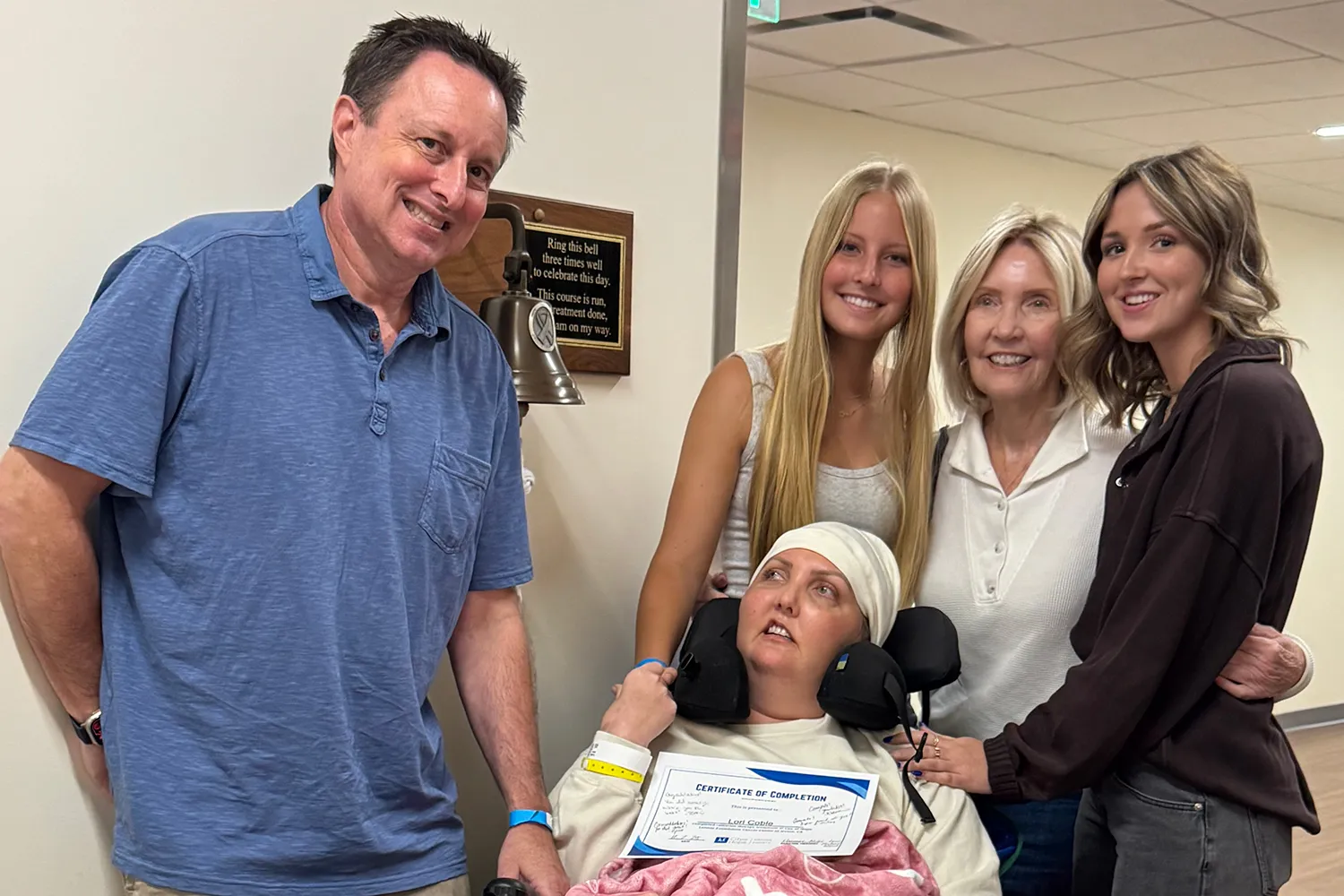
Lori rings the bell with family in November 2025.
courtesy of Chris Coble

Being home, he says, was fantastic for his wife’s mental health. She got to see her kids more often when they got home from school. Lori’s Aussiedoodle, Sadie, slept on the foot of her hospital bed.

“She was happy and making slow progress,” Chris says.

Leonard was able to visit Lori at home, and they chatted about volleyball and the kids.

“I told her how much I love her and I miss her,” Leonard says. “She said, ‘I was just thinking, ‘Why can’t it be the way it was before?’ ”

Then Lori began chemotherapy and radiation treatments. Just getting to the facility for treatment — five days a week for three weeks — took two hours.

Because Lori had lost control of her left side, she needed a special lift to get out of bed. After spending so much time lying down, she didn’t have the physical strength to sit in a normal wheelchair. “All her core strength was gone, her leg strength was gone, all her muscles were atrophied,” Chris says.

The treatment made Lori more tired and impacted her speech. Doctors were concerned that she didn’t seem to be getting better. She appeared to be getting worse.
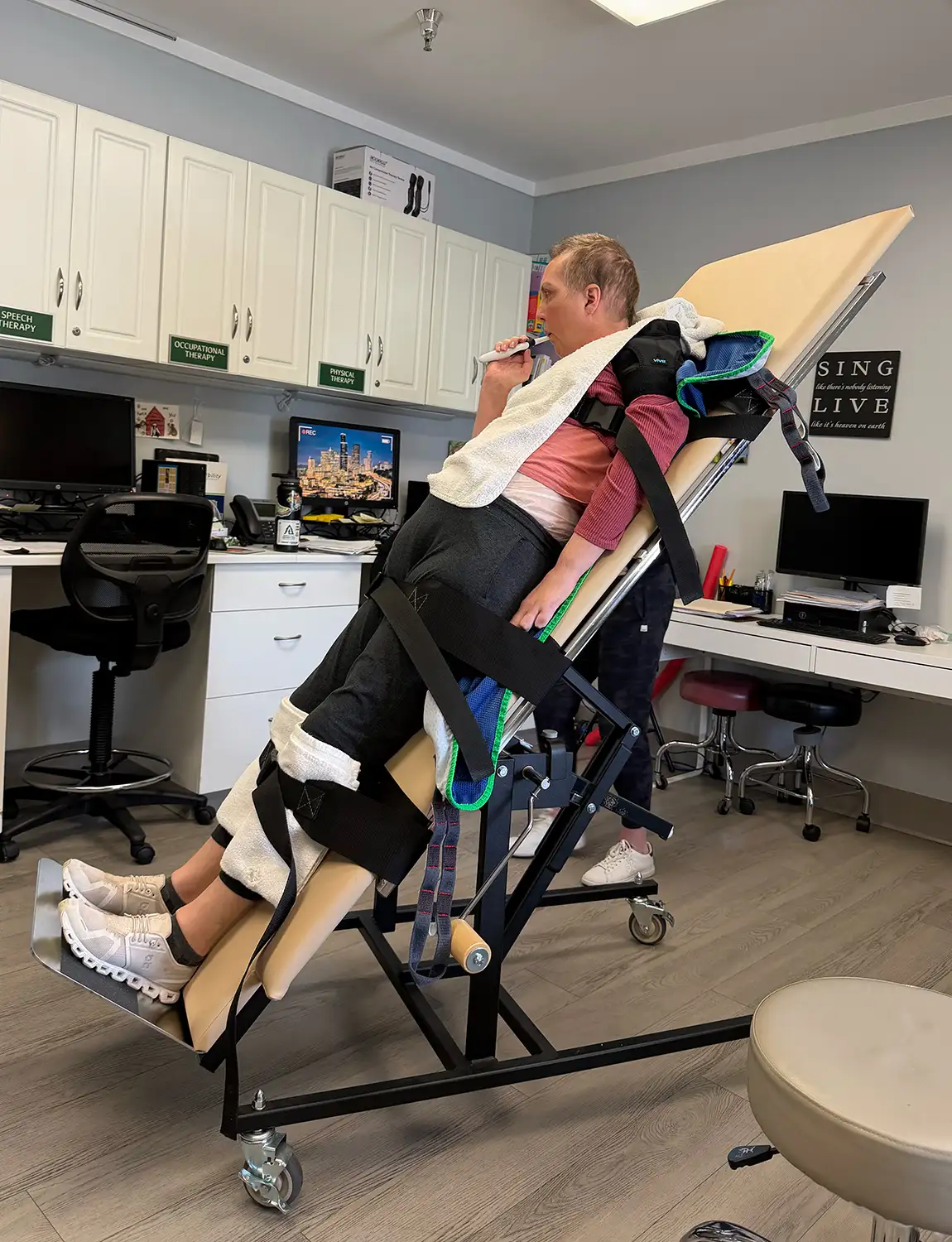
Lori at a rehabilitation facility in September 2025.
courtesy of Chris Coble

In mid-November, Chris took her to the emergency room, where doctors discovered she had a large infection in her brain. She would require yet another surgery.

“If it wasn’t dealt with that night, she would probably be dead in another day or so,” Chris recalls. “Even though Lori had told us very directly before that, ‘No more surgeries,’ I was trying to get an answer out of her. She wasn’t really responsive that evening. I’m like, ‘Honey, I know you said no more surgeries, but if we don’t do this one, you only have a couple of days left, what do we do?’ ”

They decided to go through with it.

“From a loved one’s perspective, you feel like she’s just being tortured. You’re so heartbroken for what she has to go through, over and over and over…. I’m not sure that the treatment for cancer in this situation is any better than the disease itself.”

After the surgery, Lori was weak but slowly got better. She started to speak in full sentences.

In early December, Lori felt well enough to schedule a Zoom interview with PEOPLE. But the day before the interview, she was back in the hospital with an infection in her lungs and pneumonia.

Weeks later, the infection is improving, according to Leonard. She says Lori has more cognitive abilities — enough to reiterate that she doesn’t want any more surgeries. Her family plans to bring her home for hospice care. “She wants to be home with the family and dogs, so we are grateful they can create a more advanced hospital space in the house,” Leonard says.

Chris has been on an unpaid leave of absence from work since September to care for his wife. A GoFundMe has been established to help pay for the $30,000 a month home health care she requires.

“I’m trying to make every day the best I can make it for her,” Chris says. “I don’t want to have any regrets for the rest of my life that I didn’t do everything possible every day for her.”

In the meantime, he mourns his old life.

“My wife as I knew her is gone, and I don’t know that she’s ever coming back to be the person I knew,” he says. “Everything she’s gone through, she has been punched when she’s down over and over and over and over. The fact that she’s still alive is amazing. She’s been through so much.”

“I want her to be alive for as long as possible. And I don’t know how long that is,” Chris says. “I would give my life for hers in a heartbeat. But I can’t do that. I’m helpless.”

“How could this be happening to us again?” Chris Coble says about their family’s heartbreaking trauma

Lori Coble was in standstill traffic on the freeway on May 4, 2007, when a big rig slammed into the back of her minivan. The mom from Orange County, Calif., had been driving home to put her three kids — Kyle Christopher, 5, Emma Lynn, 4, and Katie Gene, 2 — down for a nap. None of the children survived the crash.

Devastated, Lori and her husband, Chris Coble, made a pact not to end their own lives and to support each other through the traumatic aftermath. They mourned their children deeply and still wanted to be parents.

After exploring adoption and failing to reverse Chris’ vasectomy, they pursued IVF. They were left with three viable embryos: two girls and a boy. “Exactly like we lost,” says Chris, now 54.

courtesy of Chris Coble

As Lori told Oprah Winfrey in 2010, it seemed like a sign. She and Chris told the fertility doctor they wanted to implant all three, “cross our fingers and hope for the best,” Chris says.

The triplets were born almost exactly a year after the deaths of their older siblings. They each carry an older sibling’s middle name: Jake Christopher, Ashley Lynn, Ellie Gene.

“It took me over four years to come out of the fog and pain of what happened,” Chris says. “The first three years of raising the triplets you have this mix of joy and happiness and at the same time, you’re in pain on the inside. There’s these three babies and they’re all joy…. But at the same time, I was trying to avoid falling apart in front of them, I’d go into the other room and cry real quick and come back and put a smile on my face.”

Lori dove into motherhood and raising her triplets, all the while campaigning for highway safety to help protect other children.

“She is extraordinary — everybody who knows her, loves her,” says family friend, Becky Leonard, 45. “First and foremost, she’s a mom.”

Ashley, Lori, Jake, Chris and Ellie Coble in December 2022.
courtesy of Chris Coble

In June 2025, Chris noticed that 48-year-old Lori was “getting more clumsy.” She would run into walls, stub her toe on chairs, or drop drinking glasses on the floor. In early July, he noticed stroke-like symptoms. “Her mouth started to droop a little bit,” he says. “It became too much to ignore.”

On July 11, he took his wife to the ER at Mission Hospital in Mission Viejo, Calif. There she was diagnosed with a very large, very aggressive, stage 4 glioblastoma. The diagnosis of brain cancer shook their family.

“I was hoping we were done with the life-changing, life-altering disasters where life as you knew it yesterday is gone,” Chris tells PEOPLE.

Doctors told Lori she had two choices: try to fight the cancer, or make the best of the time she had left. Without treatment, they said, Lori would live about a month or two. With treatment, they estimated 12 to 15 months.

“She wanted to fight it,” Chris recalls.

The family rallied around Lori and faced the terminal diagnosis. “Everything we do is not to save her life, it’s to keep her alive as long as possible,” says Chris. “I started mourning the loss of my wife the day she got diagnosed. I didn’t have a lot of hope at the outset – and that weighed heavily on me. I was really upset, mad, angry. How could this be happening to us again?”

Lori, Jake and Chris Coble in September 2024.
courtesy of Chris Coble

Lori had her first brain surgery to resect one of the two conjoined masses on July 12. She recovered quickly, Chris recalls.

Leonard remembers visiting Lori in the hospital after that surgery. “She was steadfast: ‘This isn’t going to take me down. I’m not done,’ ” recalls Leonard. “She wants to be a grandma. She wants to be there when her kids graduate. She wants her life that she’s built so beautifully.”

Lori went home from the hospital a few days later.

But the second half of the tumor was growing rapidly; in two weeks, it had grown by 25 percent. Doctors wanted to remove it as quickly as possible, Chris recalls, as it was starting to impact her vision. The second surgery was more complicated than the first. It was riskier because it involved part of the brain that controls cognition, movement and vision.

The family traveled about 90 minutes north to cancer center City of Hope, in Duarte, Calif. There, on Aug. 1, Lori had her second, more complicated, more invasive brain surgery.

Before the surgery, the doctors informed the family that there was a 30 percent chance that she might lose motor control on her left side. “But I was generally hopeful that the 70 percent might go well,” Chris says.

Unfortunately, Lori fell into the 30 percent.

“It was a real bummer,” Chris says. “There were a lot of people in the hospital that were really pulling for her.”

Five days after the surgery, on the day she was supposed to go home from the hospital, Lori suffered a massive stroke. She was rushed into emergency surgery to relieve pressure in her brain. “She could have easily died,” Chris recalls. “The doctors told me she had a 50 percent chance to live.”

Lori was placed in a medically induced coma and needed a ventilator and feeding tube. She was in the hospital for 40 days. Chris and her mother were at her bedside daily. Chris only missed one day. “I had an emotional and physical collapse,” he admits. “I had a very binary choice on September 28th. And that’s take my own life because I don’t know if can continue, or raise my hand for help. And I did the latter.”

“That was the day I understood why caregivers have a far higher rate of suicide than the national average. … You’re just so exhausted in so much pain and emotional struggle. You just can’t, don’t want to continue.”

Meanwhile, the triplets were starting their senior year of high school, “which is supposed to be the best year,” Chris says. “But both parents were now missing.”

Lori slowly became more alert and more conscious. When she was discharged from the hospital, she was too young for a nursing home, but she required more medically trained care than a traditional, short-term rehab facility. At first, she was placed in a 15-bed hospital for people with traumatic brain injuries. Chris and the kids hung paintings and family photos and decorated her room. “But it wasn’t the right fit for her,” he says.

Lori said she wanted to come home. In October, Chris set up a “mini-hospital” in their house.

“I want the best care for Lori,” Chris says. “Day to day, my only decisions is: What’s the best for her? And how can I keep her going? Because her cancer is terminal, we’re just buying time every day.”

Lori rings the bell with family in November 2025.
courtesy of Chris Coble

Being home, he says, was fantastic for his wife’s mental health. She got to see her kids more often when they got home from school. Lori’s Aussiedoodle, Sadie, slept on the foot of her hospital bed.

“She was happy and making slow progress,” Chris says.

Leonard was able to visit Lori at home, and they chatted about volleyball and the kids.

“I told her how much I love her and I miss her,” Leonard says. “She said, ‘I was just thinking, ‘Why can’t it be the way it was before?’ ”

Then Lori began chemotherapy and radiation treatments. Just getting to the facility for treatment — five days a week for three weeks — took two hours.

Because Lori had lost control of her left side, she needed a special lift to get out of bed. After spending so much time lying down, she didn’t have the physical strength to sit in a normal wheelchair. “All her core strength was gone, her leg strength was gone, all her muscles were atrophied,” Chris says.

The treatment made Lori more tired and impacted her speech. Doctors were concerned that she didn’t seem to be getting better. She appeared to be getting worse.

Lori at a rehabilitation facility in September 2025.
courtesy of Chris Coble

In mid-November, Chris took her to the emergency room, where doctors discovered she had a large infection in her brain. She would require yet another surgery.

“If it wasn’t dealt with that night, she would probably be dead in another day or so,” Chris recalls. “Even though Lori had told us very directly before that, ‘No more surgeries,’ I was trying to get an answer out of her. She wasn’t really responsive that evening. I’m like, ‘Honey, I know you said no more surgeries, but if we don’t do this one, you only have a couple of days left, what do we do?’ ”

They decided to go through with it.

“From a loved one’s perspective, you feel like she’s just being tortured. You’re so heartbroken for what she has to go through, over and over and over…. I’m not sure that the treatment for cancer in this situation is any better than the disease itself.”

After the surgery, Lori was weak but slowly got better. She started to speak in full sentences.

In early December, Lori felt well enough to schedule a Zoom interview with PEOPLE. But the day before the interview, she was back in the hospital with an infection in her lungs and pneumonia.

Weeks later, the infection is improving, according to Leonard. She says Lori has more cognitive abilities — enough to reiterate that she doesn’t want any more surgeries. Her family plans to bring her home for hospice care. “She wants to be home with the family and dogs, so we are grateful they can create a more advanced hospital space in the house,” Leonard says.

Chris has been on an unpaid leave of absence from work since September to care for his wife. A GoFundMe has been established to help pay for the $30,000 a month home health care she requires.

“I’m trying to make every day the best I can make it for her,” Chris says. “I don’t want to have any regrets for the rest of my life that I didn’t do everything possible every day for her.”

In the meantime, he mourns his old life.

“My wife as I knew her is gone, and I don’t know that she’s ever coming back to be the person I knew,” he says. “Everything she’s gone through, she has been punched when she’s down over and over and over and over. The fact that she’s still alive is amazing. She’s been through so much.”

“I want her to be alive for as long as possible. And I don’t know how long that is,” Chris says. “I would give my life for hers in a heartbeat. But I can’t do that. I’m helpless.”

More from author

LEAVE A REPLY

Please enter your comment!
Please enter your name here

Related posts

Latest posts

New Jersey Mom Whose 2-Year-Old Son Died of the Flu Recalls His Final Days: ‘I Will Never Be the Same’

The family of a New Jersey toddler says he was discharged from the emergency room after he was diagnosed with the flu; a day later, he...

Teen Mom’s Farrah Abraham Announces Plans to Run for Mayor of Austin: ‘My Story Isn’t Just a Headline’

Former Teen Mom star Farrah Abraham is ready to explore the world of politics. “Austin, my story isn’t just a headline; it’s the blueprint for Austin’s 2026 transformation,” Abraham,...

Grief Street Podcaster Jordy Glassner Dies at Age 34 After Documenting Journey with Brain Cancer

Jordy Glassner, a podcaster who shared her life living with an aggressive brain tumor, died on Jan. 13. She was 34. “It is with profound...

Greg Biffle’s House Robbed of $30,000 Less Than a Month After NASCAR Star, Wife and Kids Die in Plane Crash

Thieves stole $30,000 in cash and a $30 backpack from the home of NASCAR champion Greg Biffle and his wife Cristina Grossu Biffle, three weeks...

ICE agents haul driver out of car as Minnesota protesters swarm them in dramatic video

A woman was yanked out of her car by federal agents for allegedly impeding an immigration enforcement operation in Minnesota on Tuesday — less than a...

Cause of Death Revealed for Missing Special Education Teacher Later Found in Lake Michigan

The cause and manner of death for the special education teacher found dead in Lake Michigan has been revealed. Following an autopsy on Tuesday, the Cook County...

Want to stay up to date with the latest news?

We would love to hear from you! Please fill in your details and we will stay in touch. It's that simple!